

How To Draw A Fbd Of A L Shaped Support Beam
Easily-on Tutorials, INTUITIVE NLP SERIES
Foundations of NLP Explained Visually: Axle Search, How It Works
A gentle guide to how Beam Search enhances predictions, in plain English
Many NLP applications such equally machine translation, chatbots, text summarization, and language models generate some text as their output. In addition applications like prototype captioning or automatic voice communication recognition (ie. Spoken language-to-Text) output text, even though they may not be considered pure NLP applications.
There are a couple of commonly used algorithms used by all of these applications as part of their final pace to produce their final output.
- Greedy Search is one such algorithm. It is used often considering it is simple and quick.
- The alternative is to use Axle Search. It is very popular because, although it requires more than computation, information technology usually produces much better results.
In this article, I will explore Beam Search and explain why it is used and how it works. We will briefly touch on upon Greedy Search as a comparison so that we can understand how Axle Search improves upon it.
Also, if you lot are interested in NLP, I have a few more articles that you might find useful. They explore other fascinating topics in this infinite such as Transformers, Spoken language-to-Text, and Bleu Score metrics.
- Transformers Explained Visually: Overview of functionality (How Transformers are used, and why they are improve than RNNs. Components of the architecture, and behavior during Preparation and Inference)
- How Transformers piece of work, step-past-step (Internal operation cease-to-end. How data flows and what computations are performed, including matrix representations)
- Automatic Speech Recognition (Speech-to-Text algorithm and compages, using CTC Loss and Decoding for aligning sequences.)
- Bleu Score (Bleu Score and Word Mistake Rate are two essential metrics for NLP models)
Nosotros'll get-go past getting some context regarding how NLP models generate their output and so that nosotros can sympathise where Axle Search (and Greedy Search) fits in.
NB: Depending on the problem they're solving, NLP models can generate output every bit either characters or words. All of the concepts related to Beam Search apply equivalently to either, so I volition use both terms interchangeably in this commodity.
How NLP models generate output
Allow'southward accept a sequence-to-sequence model every bit an case. These models are frequently used for applications such as machine translation.
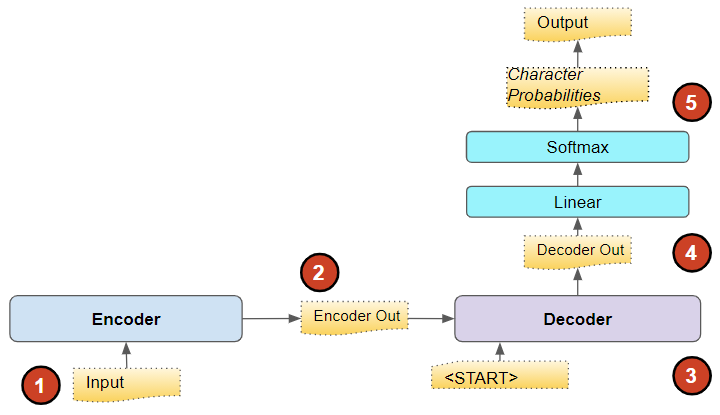
For instance, if this model were being used to translate from English language to Spanish, information technology would take a sentence in the source linguistic communication (eg. "You are welcome" in English language) as input and output the equivalent sentence in the target linguistic communication (eg. "De zip" in Spanish).
Text is a sequence of words (or characters), and the NLP model constructs a vocabulary consisting of the entire set of words in the source and target languages.
The model takes the source judgement equally its input and passes it through an Embedding layer followed by an Encoder. The Encoder then outputs an encoded representation that compactly captures the essential features of the input.
This representation is then fed to a Decoder along with a "<First>" token to seed its output. The Decoder uses these to generate its own output, which is an encoded representation of the sentence in the target language.
This is then passed through an output layer, which might consist of some Linear layers followed by a Softmax. The Linear layers output a score of the likelihood of occurrence of each discussion in the vocabulary, at each position in the output sequence. The Softmax and so converts those scores into probabilities.
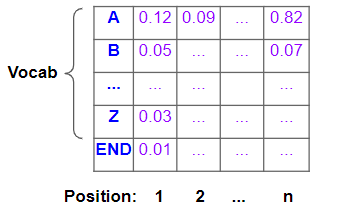
Our eventual goal, of grade, is not these probabilities but a final target sentence. To get that, the model has to decide which word it should predict for each position in that target sequence.

How does it do that?
Greedy Search
A fairly obvious mode is to simply take the word that has the highest probability at each position and predict that. It is quick to compute and easy to sympathize, and oftentimes does produce the right result.

In fact, Greedy Search is so easy to understand, that nosotros don't need to spend more time explaining it 😃. Just tin nosotros practice meliorate?
Aha, finally that brings the states to our real topic!
Beam Search
Axle Search makes two improvements over Greedy Search.
- With Greedy Search, nosotros took just the single best discussion at each position. In contrast, Beam Search expands this and takes the all-time 'N' words.
- With Greedy Search, we considered each position in isolation. Once we had identified the best word for that position, we did not examine what came before information technology (ie. in the previous position), or after it. In contrast, Axle Search picks the 'Northward' best sequences so far and considers the probabilities of the combination of all of the preceding words forth with the give-and-take in the electric current position.
In other words, it is casting the "calorie-free beam of its search" a little more broadly than Greedy Search, and this is what gives information technology its name. The hyperparameter 'N' is known as the Axle width.
Intuitively information technology makes sense that this gives us ameliorate results over Greedy Search. Because, what we are actually interested in is the best complete sentence, and nosotros might miss that if we picked simply the best private word in each position.
Beam Search — What it does
Let's take a simple case with a Axle width of 2, and using characters to proceed it simple.
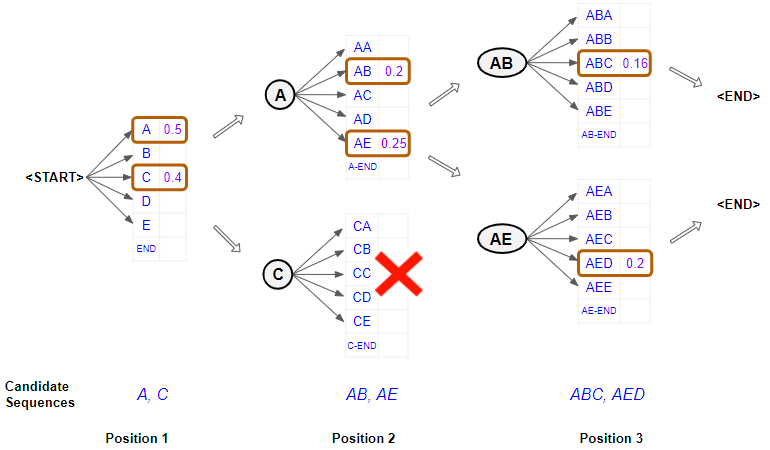
First Position
- Consider the output of the model at the outset position. It starts with the "<START>" token and obtains probabilities for each word. Information technology now selects the two best characters in that position. eg. "A" and "C".
Second Position
- When it comes to the second position, it re-runs the model twice to generate probabilities by fixing the possible characters in the first position. In other words, it constrains the characters in the first position to exist either an "A" or a "C" and generates ii branches with two sets of probabilities. The branch with the first set of probabilities corresponds to having "A" in position 1, and the branch with the second set corresponds to having "C" in position 1.
- It at present picks the overall two best graphic symbol pairs based on the combined probability of the beginning 2 characters, from out of both sets of probabilities. So it doesn't pick just one best grapheme pair from the showtime gear up and one best character pair from the 2nd set. eg. "AB" and "AE"
Third Position
- When it comes to the third position, information technology repeats the process. It re-runs the model twice by constraining the first two positions to be either "AB" or "AE" and once again generates ii sets of probabilities.
- Once again, information technology picks the overall two best graphic symbol triplets based on the combined probability of the beginning three characters from both sets of probabilities. Therefore we now accept the two best combinations of characters for the first three positions. eg. "ABC" and "AED".
Repeat till END token
- Information technology continues doing this till information technology picks an "<END>" token as the best grapheme for some position, which and then concludes that co-operative of the sequence.
It finally ends up with the two best sequences and predicts the one with the higher overall probability.
Axle Search — How information technology works
We now understand Beam Search at a conceptual level. Permit'due south become ane level deeper and understand the details of how this works. Nosotros'll continue with the same example and use a Beam width of 2.
Continuing with our sequence-to-sequence model, the Encoder and Decoder would probable be a recurrent network consisting of some LSTM layers. Alternately information technology could besides be congenital using Transformers rather than a recurrent network.

Permit's focus on the Decoder component and the output layers.
Kickoff Position
In the beginning timestep, it uses the Encoder's output and an input of a "<START>" token to generate the graphic symbol probabilities for the first position.

Now it picks two characters with the highest probability eg. "A" and "C".
Second Position
For the second timestep, it then runs the Decoder twice using the Encoder's output as earlier. Along with the "<START>" token in the kickoff position, it forces the input of the 2d position to be "A" in the first Decoder run. In the 2nd Decoder run, it forces the input of the second position to be "C".

Information technology generates grapheme probabilities for the second position. But these are private character probabilities. Information technology needs to compute the combined probabilities for graphic symbol pairs in the starting time 2 positions. The probability of the pair "AB" is the probability of "A" occurring in the first position multiplied by the probability of "B" occurring in the second position, given that "A" is already fixed in the kickoff position. The example beneath shows the calculation.

It does this for both Decoder runs and picks the character pairs with the highest combined probabilities beyond both runs. It, therefore, picks "AB" and "AE".

Tertiary Position
For the tertiary fourth dimension footstep, it once again runs the Decoder twice as earlier. Along with the "<START>" token in the offset position, it forces the input of the second position and tertiary positions to be "A" and "B" respectively in the kickoff Decoder run. In the second Decoder run, information technology forces the input of the 2nd position and third positions to exist "A" and "Eastward" respectively.
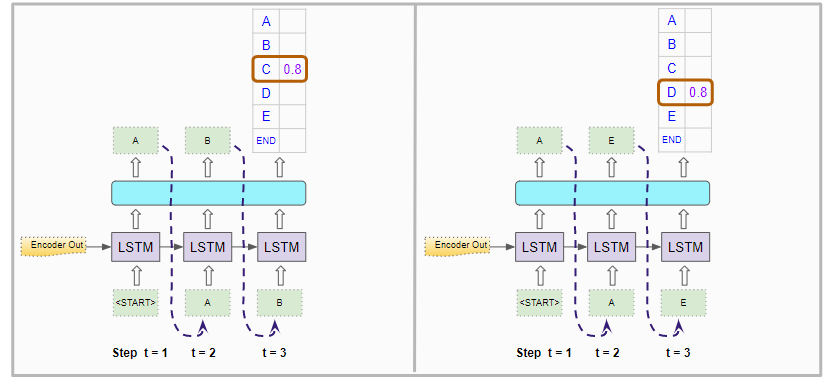
It calculates the combined probability for graphic symbol triples in the start three positions.

It picks the two best ones beyond both runs, and therefore picks "ABC" and "AED".

Repeat till END token
Information technology repeats this process till it generates 2 best sequences that end with an "<END>" token.
It then chooses the sequence that has the highest combined probability to make its concluding prediction.
Conclusion
This gives u.s.a. a sense of what Beam Search does, how information technology works, and why information technology gives us better results. This comes at the expense of increased computation, and longer execution times. And so we should evaluate whether that tradeoff makes sense for our application's use example.
And finally, if you liked this article, yous might likewise enjoy my other serial on Sound Deep Learning, Geolocation Machine Learning, and Image Caption architectures.
Let's proceed learning!

Source: https://towardsdatascience.com/foundations-of-nlp-explained-visually-beam-search-how-it-works-1586b9849a24
Posted by: alcarazliplet.blogspot.com
0 Response to "How To Draw A Fbd Of A L Shaped Support Beam"
Post a Comment